Case Study Travel · 2026

ViaSet

The Bloomberg of Travel.

Not a travel agency. A Travel FinTech infrastructure — built to decouple the booking decision from the capital commitment. Indian consumers lock future prices via UPI, receive tickets on WhatsApp, and manage bookings as financial assets in a personal portfolio.

Role Lead Product Designer
Scope End-to-end UX & UI
Platform Web App
Industry Travel · Hospitality
Market India
Year 2026
viaset.com
ViaSet — Explore
Studio ux.ui.dan
Lead Product Design
Deliverables UX Strategy & Architecture
Smart Lock Flow Design
Bachat Savings UI
UPI Intent Checkout
WhatsApp Trust Layer
Portfolio Dashboard
Design System & Handoff
Design Philosophy UPI-first · WhatsApp-first · Bachat-first
Core Challenge Making institutional FinTech infrastructure feel invisible — so users just feel trust

Overview

Travel FinTech. Not a travel agency.

ViaSet is not an OTA. It is a Travel FinTech Infrastructure company — a Smart Orchestration Layer that connects UPI payments, corporate virtual cards, and global travel suppliers inside a single regulated pipe. Users pay in INR via UPI. The platform handles the rest: corporate VCC issuance, cross-border supplier payment, three-way reconciliation, and WhatsApp delivery of the ticket. All in under 60 seconds.

The core innovation is the Smart Lock — a mechanism that decouples the booking decision from the capital commitment. Users lock a future travel price by paying a small deposit today. If plans change, that deposit converts to credits at full value. If they proceed, the balance is settled at checkout. At no point does the user feel like they're taking a risk — because they aren't.

Our design challenge was significant: make one of the most complex regulatory and financial architectures in Indian FinTech feel like the simplest booking experience on the market.
The Problem

"India is a high-friction market for cross-border travel. Traditional OTA models fail because they are fundamentally misaligned with how India pays, saves, and trusts."

The Indian travel market isn't just underserved — it's actively hostile to the models that work elsewhere. Credit card penetration is low, cross-border transaction failure rates exceed 40%, a 20% TCS applies to overseas tour packages, and individual outward remittances face LRS caps that make B2C scaling almost impossible. The UX challenge and the infrastructure challenge were one and the same.

01

Card failure kills conversion

Cross-border card transactions fail at rates exceeding 40% for Indian users — OTP friction, 3DS rules, issuer risk models. Every checkout built around a card form is designed to fail in India. The only payment method that works is UPI.

02

The TCS Wall adds 20% to every booking

A mandatory 20% Tax Collected at Source applies to "Overseas Tour Packages" — effectively pricing millions of travelers out of legitimate international booking. The product architecture had to be designed around this regulatory constraint from day one.

03

Booking anxiety stops planning before it starts

Indian consumers distrust websites, distrust early commitment, and distrust cancellation policies. The mental model is: "I'll wait and see." The design challenge was making early booking feel safer than waiting — through transparency, framing, and a mechanic that genuinely eliminated the risk.

The Core Innovation

The Smart Lock.
Not a deposit. An asset.

The central design challenge was naming and framing. The word "deposit" in India evokes chit funds and unregistered schemes. The word "wallet" triggers regulatory red flags. We landed on Smart Lock — a financial optimization tool that lets users secure today's price against tomorrow's volatility. The framing shifts from "paying in advance" to "making a smart financial move." Designing that shift clearly, confidently, and repeatedly across every screen was the work.

Step 01

Lock price with a Smart Deposit

Pay a small upfront amount via UPI — GPay, PhonePe, or Paytm. No card entry, no forms. The price is locked. The AI Prediction Engine shows you why now is the right moment.

Step 02

Ticket delivered via WhatsApp

Booking confirmation, PDF ticket, and tax invoice arrive instantly on WhatsApp. Not email. Not an app notification. WhatsApp — because that's where Indian consumers actually trust what they receive.

Step 03

Manage bookings as a Portfolio

The dashboard is called "My Portfolio" — not "My Trips." Each locked booking shows its current market value vs. your locked price, with a live profit indicator. Bookings are financial assets, and the UI reflects that.

Step 04

Plans change? Full value, no loss.

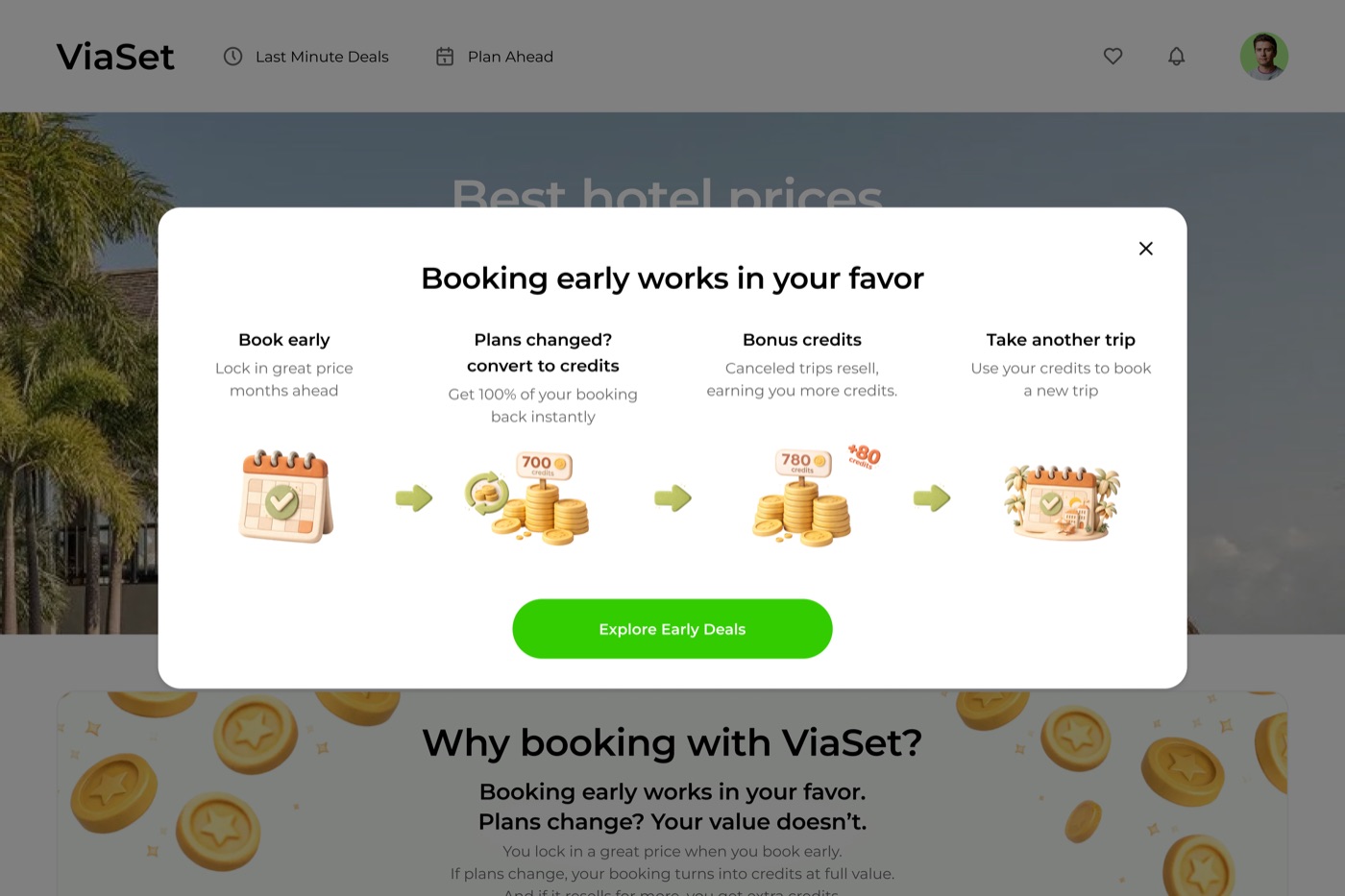
If plans change, the Smart Lock converts to credits at full booking value. Not a partial refund. Not a voucher. The user never feels punished — and never has a reason to hesitate next time.

ViaSet — Why Book with ViaSet modal
The "Why ViaSet?" modal — surfaced contextually on the explore page to build confidence at the moment of hesitation

Explore & Discover

Two types of traveler.
One home screen.

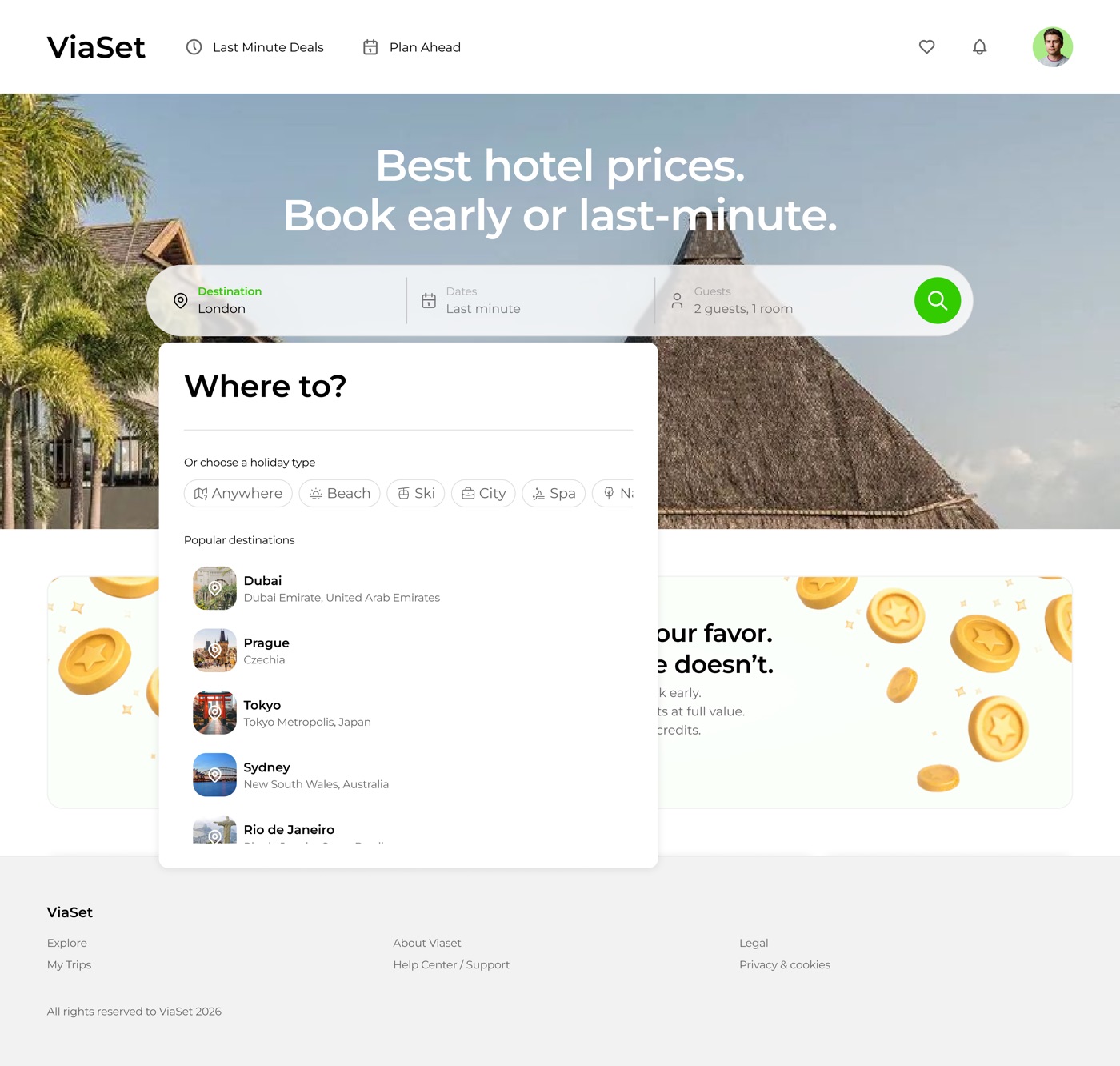
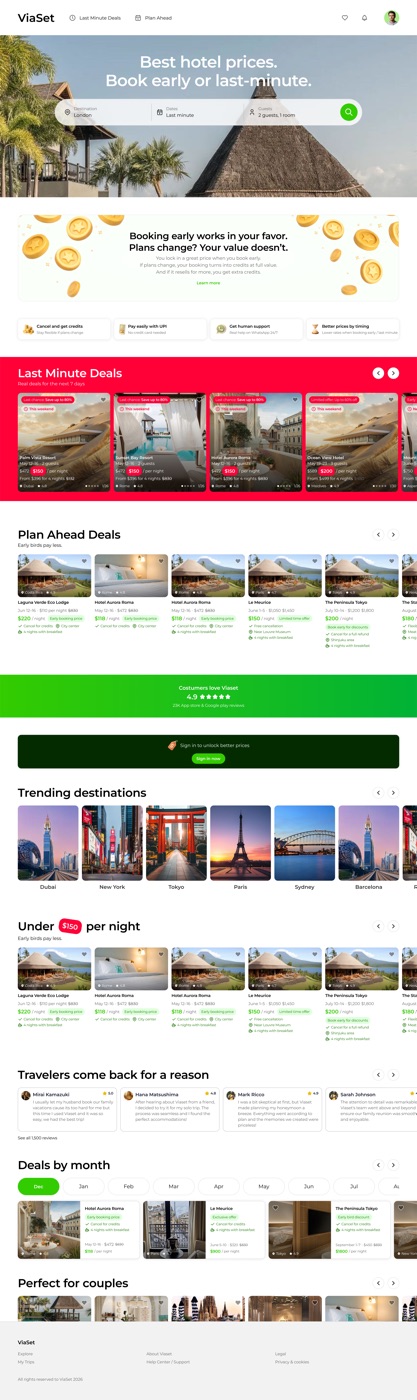
ViaSet surfaces a persistent navigation choice right from the header: Last Minute Deals for the spontaneous traveler, Plan Ahead for the deliberate one. The home screen then serves both simultaneously — curated sections for each intent, without making either group feel like a secondary user. Search is immediate, categorised by holiday type, and pre-populated with the destinations Indian travelers actually search for.

ViaSet — Where to search
Search — "Where to?" with holiday type filters and popular destinations
ViaSet — Search results
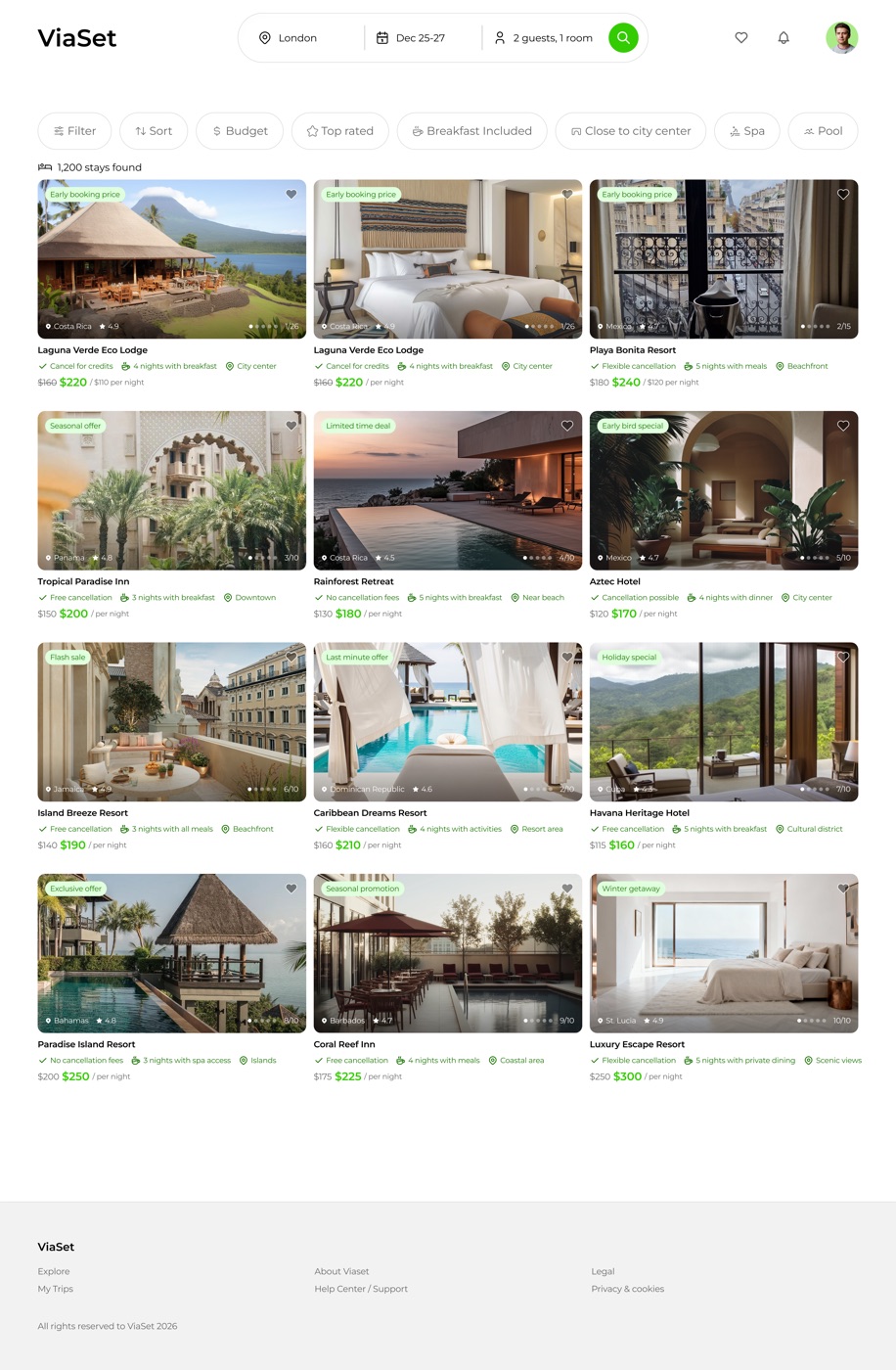
Results — Rich hotel cards with trust signals, price per night, and amenity badges at a glance
ViaSet — Date picker
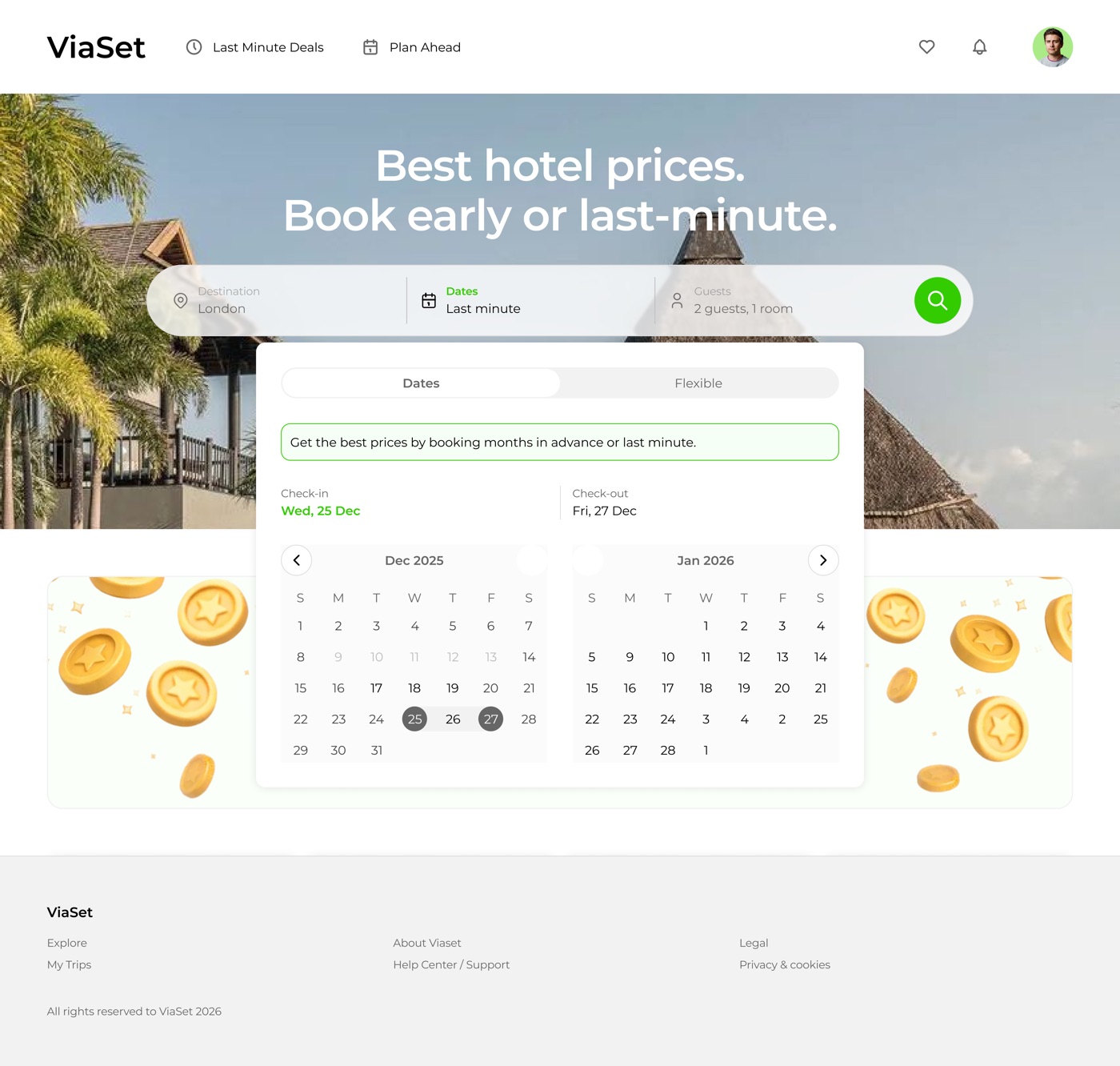
Date selection — Inline calendar with check-in / check-out clarity
ViaSet — Guest selector
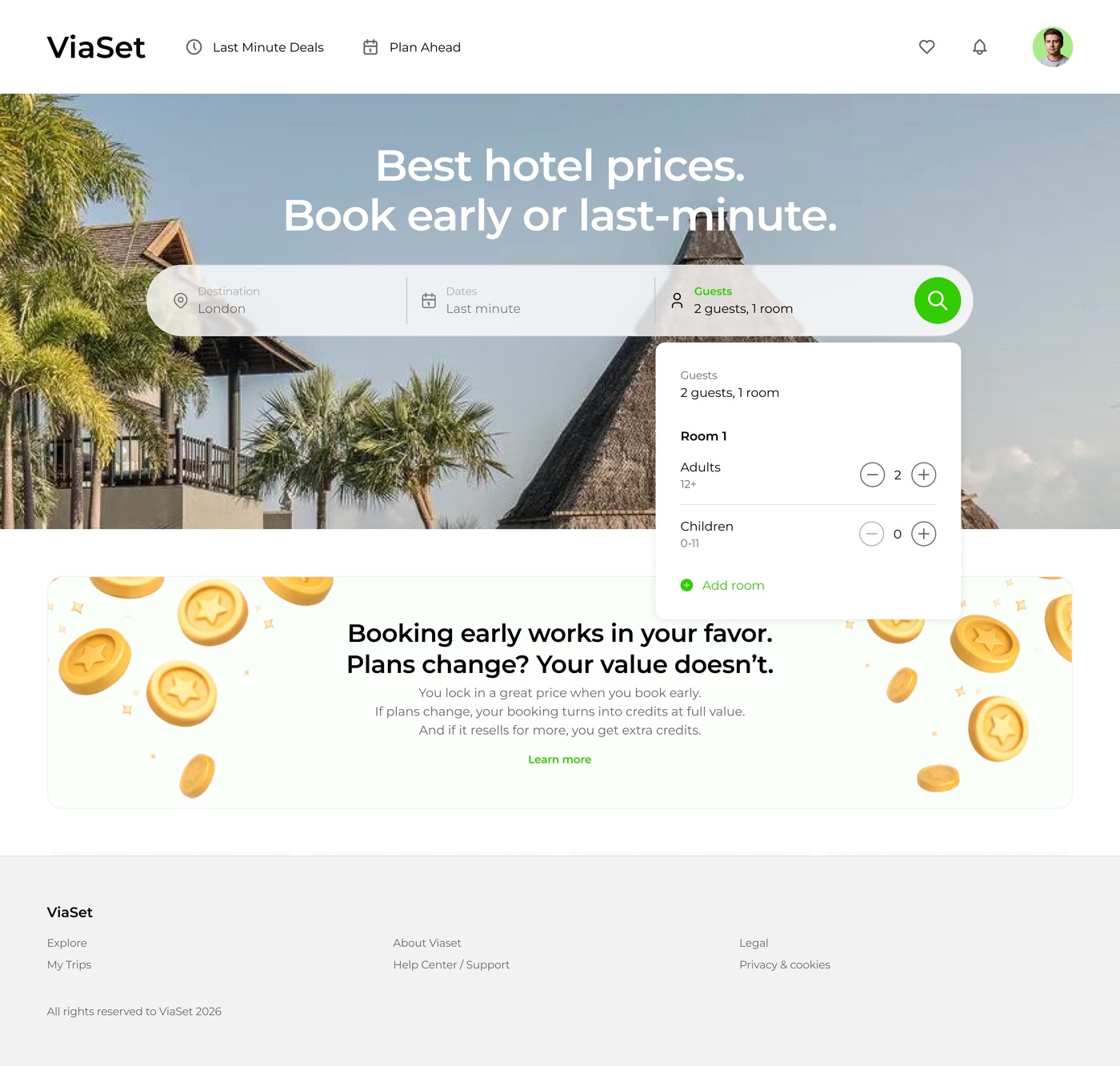
Guest selector — Simple, minimal, no cognitive load

Hotel Details

Everything you need
to say yes.

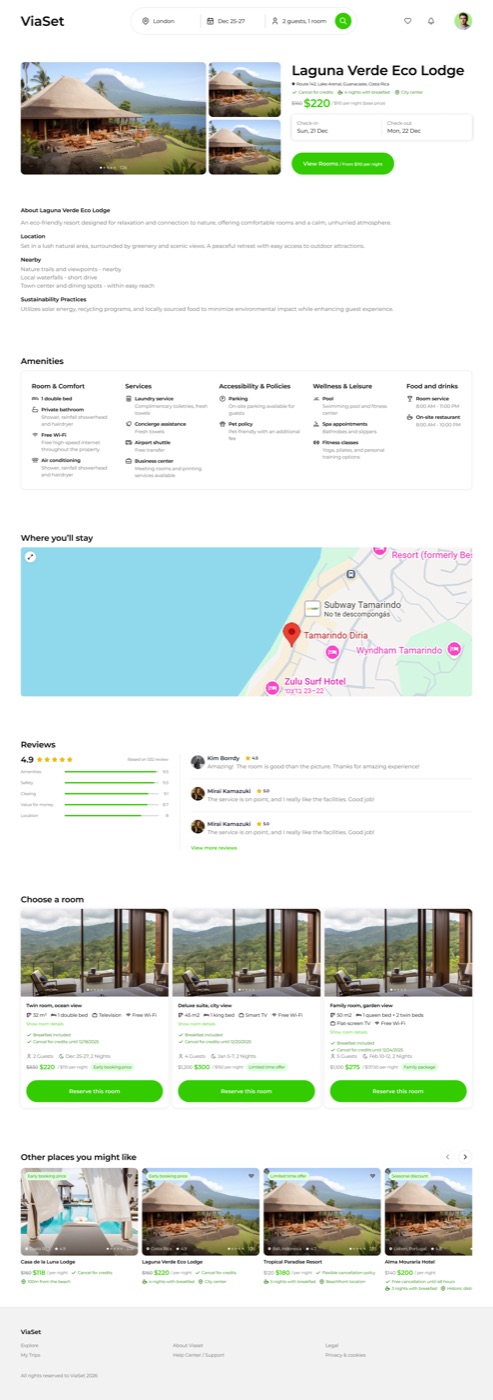
The hotel detail page was designed around a single conversion goal: give users enough information to book with confidence, without overwhelming them. Photos, sustainability tags, amenities, a live map, verified reviews, and room-level selection are all surfaced in a single, scrollable flow — with the booking CTA persistent throughout.

viaset.com/hotel/laguna-verde-eco-lodge
ViaSet — Hotel Details page
Hotel Details — Laguna Verde Eco Lodge. Photos, amenities, map, reviews, and room selection in one flow.

The Booking Flow

UPI Intent.
60 seconds. Done.

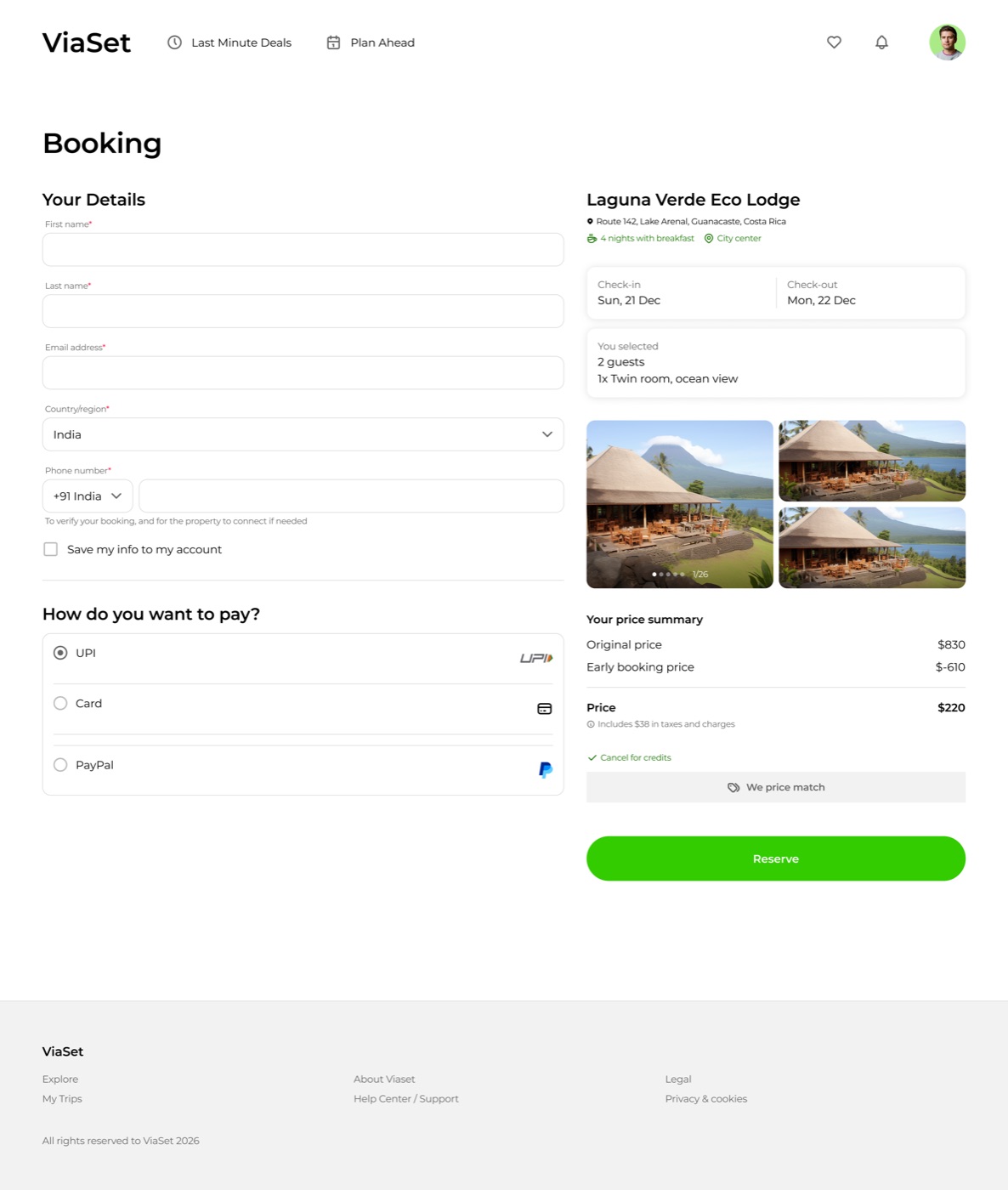
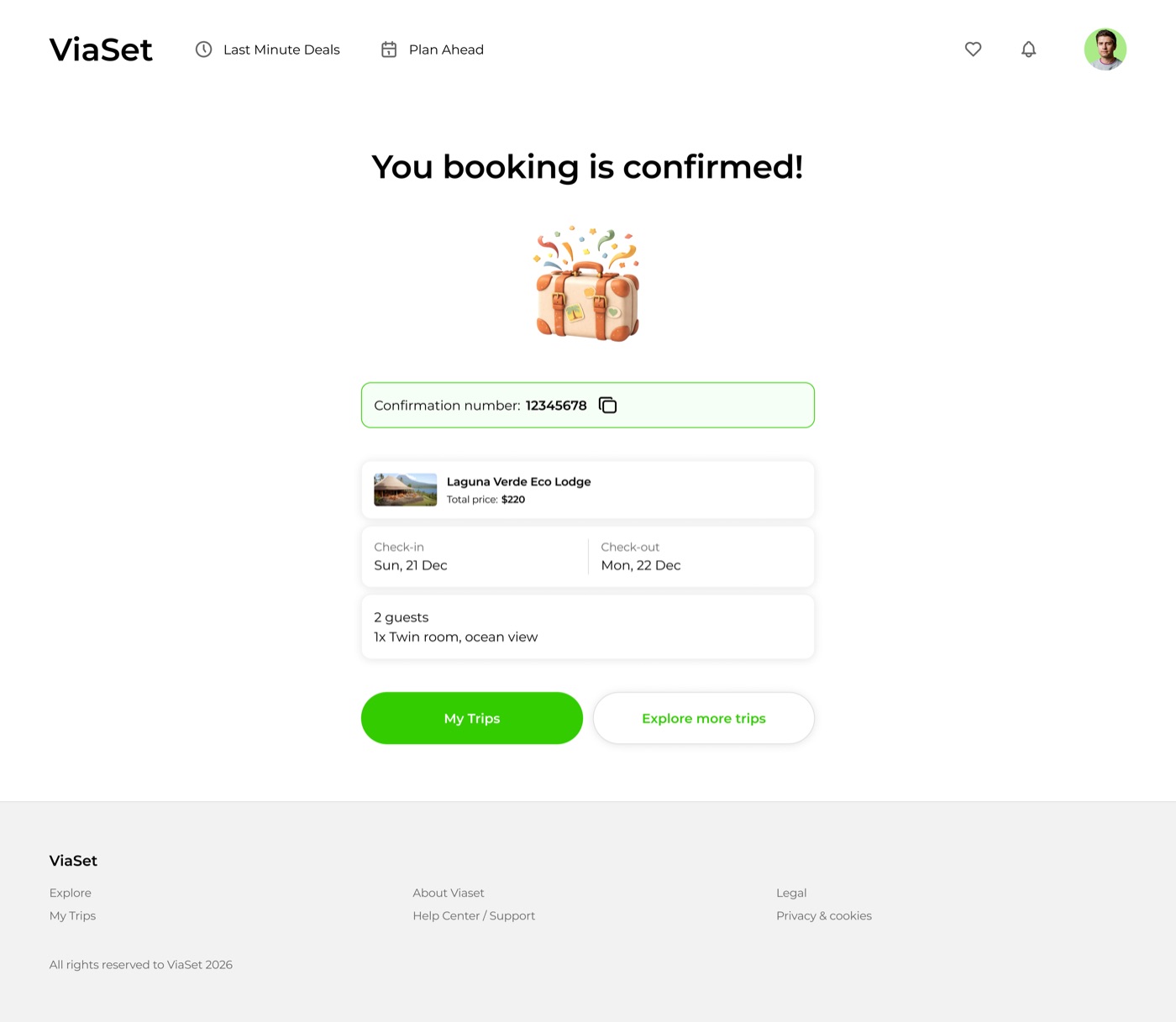
The checkout was built around one constraint: users drop off the moment they see a card form. UPI is the default and dominant payment method — displayed as large, immediately recognisable buttons for GPay, PhonePe, and Paytm. The price summary shows the full Bachat breakdown — original price crossed out, early-booking price prominent, savings in rupees. Confirmation arrives on WhatsApp before the user has scrolled to the bottom of the success screen.

ViaSet — Booking checkout
Checkout — UPI-first payment, India phone prefix, live price summary with early-booking savings clearly shown
ViaSet — Booking confirmed
Confirmation — Clean, celebratory, and immediately actionable

Rewards & Credits

Loyalty that
actually makes sense.

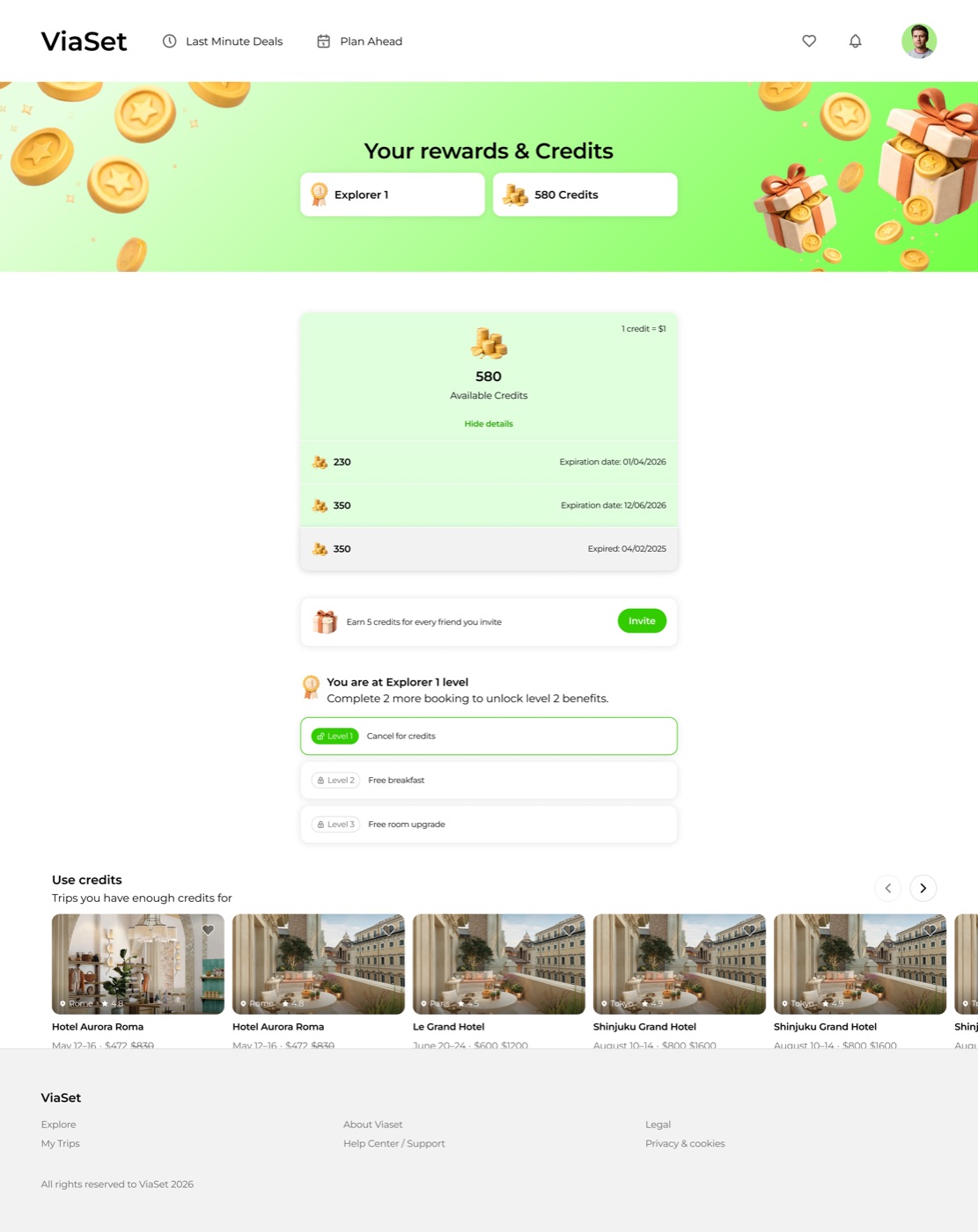
Most travel loyalty programs hide their value behind points-to-currency conversions that make users feel like they're constantly losing out. ViaSet's rewards screen makes credits tangible: your balance is front and centre, each credit batch shows its expiry, your Explorer tier is clearly displayed with a visible path to the next level, and applicable hotels are surfaced immediately beneath your balance so you know exactly what your credits can unlock right now.

viaset.com/rewards
ViaSet — Rewards and Credits
Rewards — Explorer 1 tier, 580 credits, expiry dates per batch, progress to next tier, and applicable hotels shown inline

Design Principles

What guided
every decision.

01 — Bachat-first

Savings in rupees, not percentages

Indians are value-hunters, but percentages are abstract. Every savings display shows the tangible equivalent: "You saved ₹12,000 — a return flight to Goa." The Bachat widget makes value concrete, immediate, and sharable. It's not a discount — it's a story the user tells themselves.

02 — WhatsApp-first

WhatsApp is the trust layer

Indian consumers often distrust websites but strongly trust WhatsApp. Every booking confirmation, PDF ticket, and tax invoice arrives via WhatsApp Business API — instantly. The app doesn't fight for trust. It outsources trust to the channel that already has it.

03 — UPI Intent

Zero typing. Zero forms. Zero drop-off.

The checkout is GPay / PhonePe / Paytm as large selectable buttons. On mobile, UPI Intent deep-links directly to the user's preferred app. On desktop, a dynamic QR code appears. No VPA typing. No card entry. No form that can fail. The fewer decisions, the higher the conversion.